Blog
How to write a customer service SOP for a virtual assistant
A good customer service SOP tells a virtual assistant three things for each common ticket: what to check, what to send, and what they may decide alone. Start with the two tickets every store gets, "Where is my order?" and a refund request. Write each one as numbered steps, set a refund limit in dollars, and add one rule for when the agent must stop and ask you. Below is a worked example you can copy and adapt.
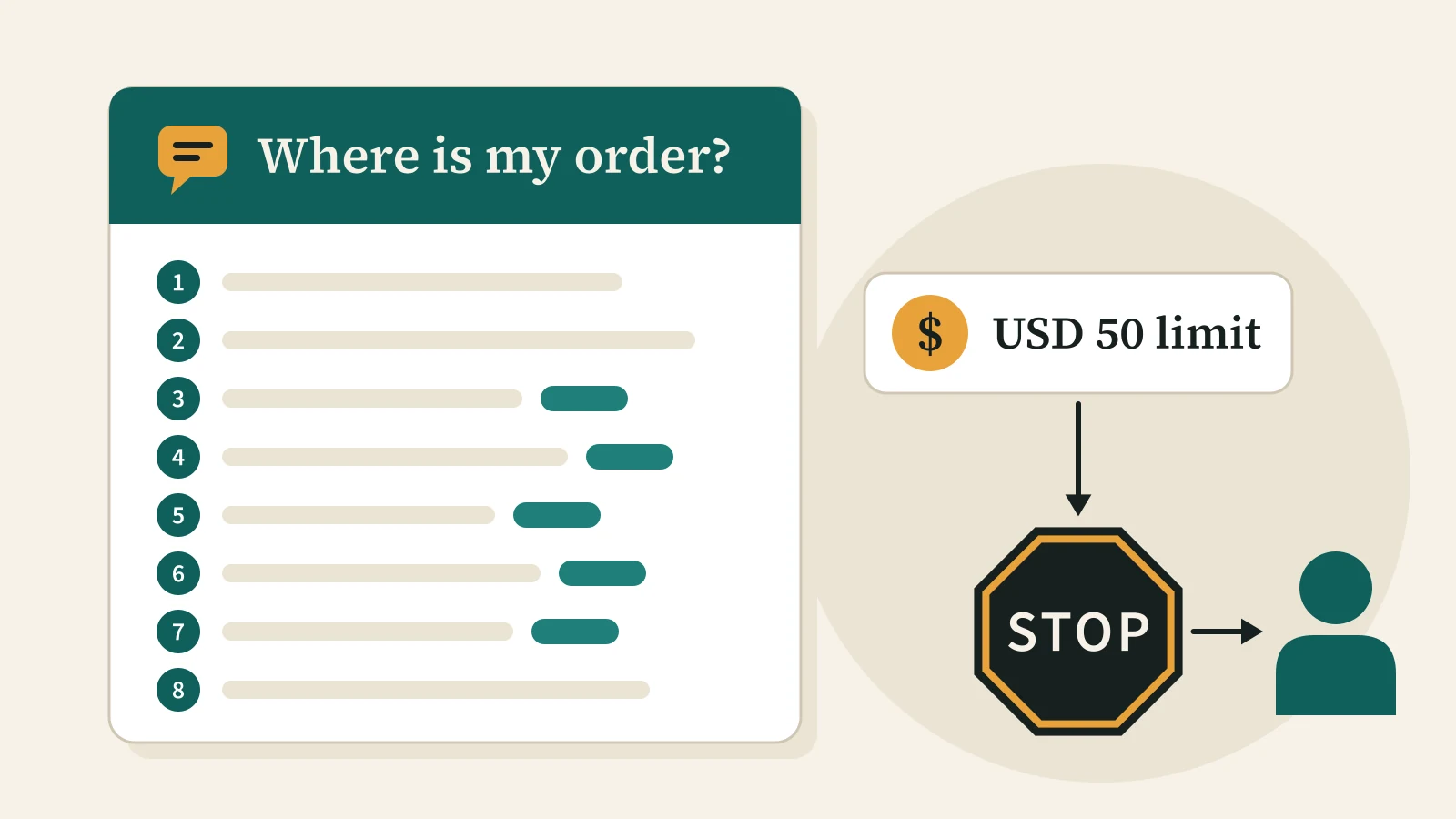
Quick answer
- Write one customer service SOP per ticket type, as numbered steps.
- Start with two tickets every store gets: "Where is my order?" (WISMO) and refund requests.
- Each one has six parts: trigger, checks, steps, saved reply, the agent's limit, and when to stop and ask.
- Put a dollar figure on refunds, for example USD 50. Anything above needs your yes.
- Use one escalation rule: outside the SOP, the agent sends a holding reply, tags it for you and moves on.
- In the US, if an order will ship late, you must offer a delay or a cancel with a refund before your shipping deadline.
What is a customer service SOP?
A customer service SOP is a page of numbered steps that tells an agent how to handle one type of ticket. The US Environmental Protection Agency calls a standard operating procedure "a set of written instructions that document a routine or repetitive activity" (EPA guidance on SOPs, April 2007).
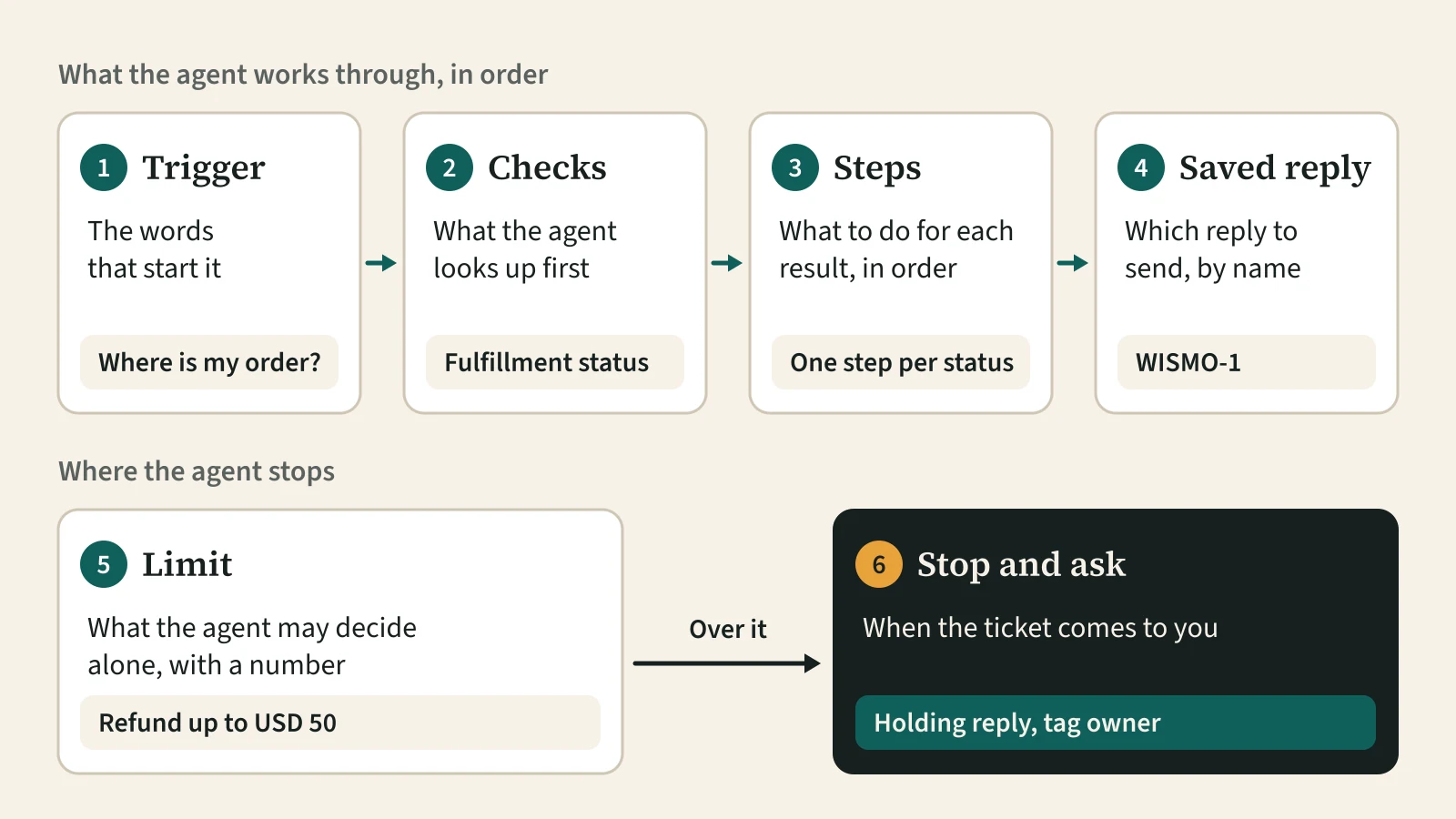
I give each customer service SOP the same six parts:
- Trigger. The words that start it, such as "Where is my order?"
- Checks. What the agent looks up first.
- Steps. What to do for each result, in order.
- Saved reply. Which reply to send, by name.
- Limit. What the agent may decide alone, with a number.
- Stop and ask. When the ticket comes to you.
Write it for someone who has never seen your store.
How does an agent handle "Where is my order?" step by step?
The agent finds the order, reads its status, and sends one of five saved replies. Here is a worked customer service SOP for a Shopify store. The wait times are examples, so set your own.
SOP 1: "Where is my order?"
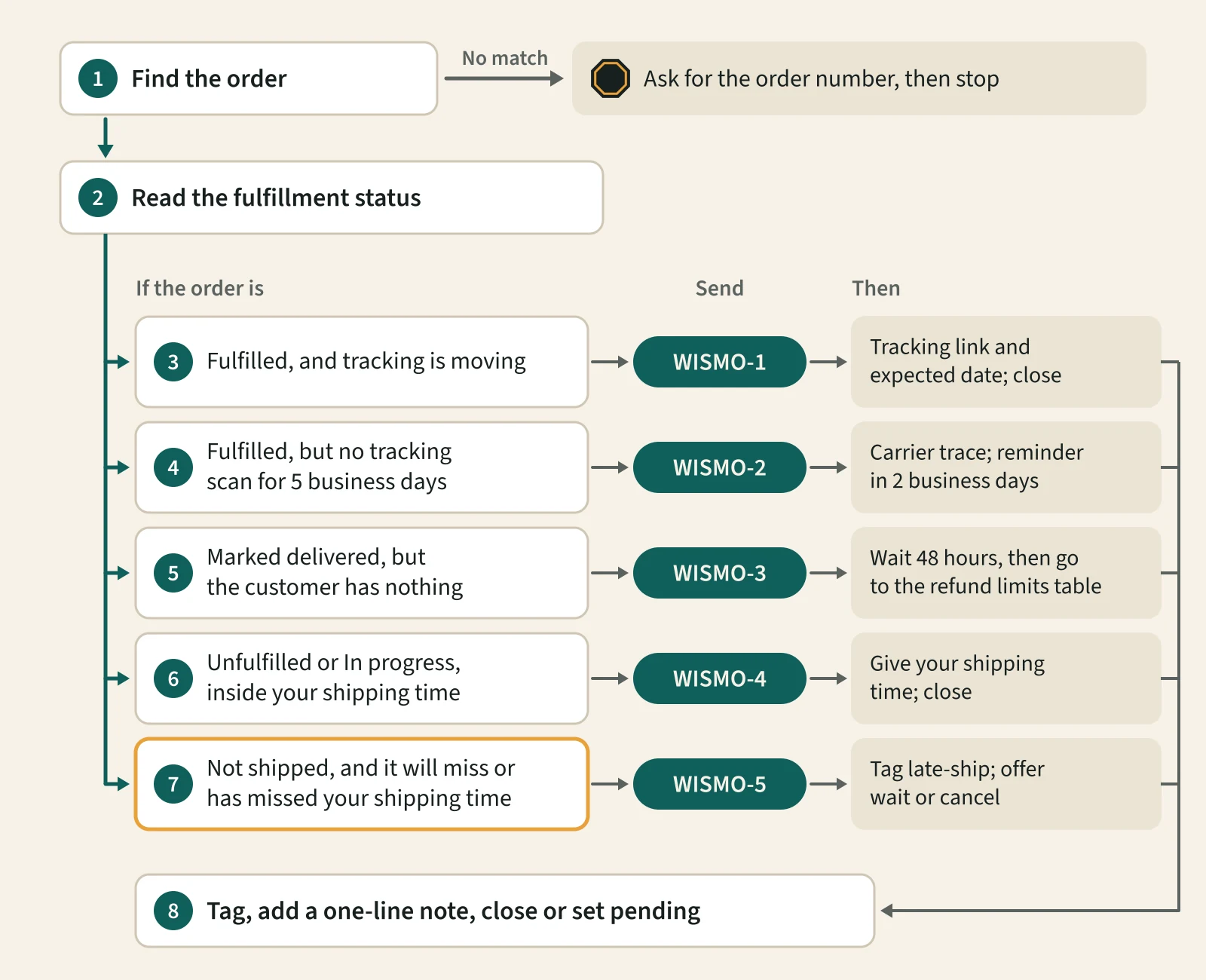
- Find the order by order number or email. If none matches, ask for the order number and stop.
- Read the fulfillment status. Shopify shows statuses such as Unfulfilled, In progress, On hold, Partially fulfilled and Fulfilled (Shopify Help Center).
- Fulfilled, and tracking is moving: send reply WISMO-1 with the tracking link and the carrier's expected date. Close the ticket.
- Fulfilled, but no tracking scan for 5 business days: send WISMO-2, open a trace with the carrier, and set a reminder for 2 business days.
- Marked delivered, but the customer has nothing: send WISMO-3. Ask them to check with neighbors and the mailroom, then wait 48 hours. If it is still missing, go to the refund limits table.
- Unfulfilled or In progress, and inside your shipping time: send WISMO-4 with your stated shipping time. Close the ticket.
- Not shipped, and it will miss or has missed your shipping time: do not guess a date. Tag it
late-shipand send WISMO-5. It gives the date your warehouse confirms, or says none is known, and offers to wait or cancel for a full refund. - Tag the ticket, add a one-line note, and close it or set it to pending.
In the US, step 7 is a legal duty. Under the FTC's mail order rule, you must ship in the time you stated, or in 30 days if you stated none (FTC business guide). If you cannot, you must offer the buyer the delay or a cancel without being asked, and before that deadline passes (16 CFR 435.2). So do not wait for the customer to write: have whoever ships flag late orders early, and send WISMO-5 then. For most payments, the refund is due within seven working days of the cancel.
How should a refund request be handled?
The agent confirms the order, checks the reason against your policy, and refunds only within your limit.
SOP 2: Refund request
- Find the order and read the payment status. If it already shows Refunded or Partially refunded, send REFUND-0 with the date and amount. Close the ticket.
- Name the reason: changed mind, damaged or faulty, wrong item, not delivered, or late.
- Check your policy for that reason. For damage, ask for a photo before you refund.
- Check the refund limits table below. Outside it, follow the escalation rule.
- Issue the refund in Shopify: open the order, choose Refund, pick the items, and untick Restock items unless they came back, since it is ticked by default. Shopify allows partial refunds up to the order total (Shopify Help Center).
- Send REFUND-1 with the amount and method. If the money does not show, the customer asks the bank or card issuer they paid with.
- Tag the ticket with the reason, and close it.
Give the agent a staff account with only the refund rights the customer service SOP needs. Shopify lists "Refund to original payment method" and "Refund to store credit" as separate permissions (Shopify store permissions). My post on giving a VA access without your password covers the rest of the boxes to tick.
Your refund rules also depend on where customers live. In the UK, an online buyer can usually cancel within 14 days after the goods arrive (regulation 30). The refund is due within 14 days of getting the goods back, or of proof they were sent if that comes first (regulation 34). In Australia, a change of mind gives no right to a refund unless your policy offers one. A major fault lets the buyer choose a refund or a replacement (ACCC). In both countries, the refund goes back the way they paid unless the customer agrees otherwise. This is not legal advice, so check each country you sell to.
What can the agent refund without asking you?
The agent may refund alone up to an amount you choose, only for the cases your customer service SOP lists. The USD 50 below is an example. Pick a figure you would not mind losing on a mistake.
| Situation | The agent may do alone | Needs your yes |
|---|---|---|
| Changed mind, inside your return window | Send the return steps; refund once the item is back | Any request outside the window |
| Damaged or faulty, with a photo | Replace, or refund up to USD 50 | Over USD 50, or no photo |
| Marked delivered, still missing after 48 hours | Reship, or refund up to USD 50, once per customer | A second claim from the same customer |
| Late and not shipped | Offer the wait-or-cancel choice; refund in full if they cancel | Any extra credit or discount |
| Chargeback or payment dispute already open | Nothing: tag it and pass it on | Always yours |
| Refund to a different card or account | Never | Never: original method, or store credit if the customer agrees |
The escalation rule. The agent stops when a ticket is outside the SOP or over the limit. The same goes for a lawyer, a chargeback, a safety issue, or a third message on one problem. They send a holding reply that says when you will answer, and tag the ticket owner. Then they write a three-line note: what happened, what the customer wants, and what they suggest.
How does the SOP feed macros and quality checks?
Each step that sends a message becomes a saved reply, or macro, and each decision becomes a line to check. Names in the customer service SOP, such as WISMO-1, should match your help desk replies exactly. When a policy changes, update the SOP first. The e-commerce support page covers how a store agent builds and keeps those replies.
The same steps make a QA scorecard, the checklist a reviewer uses to grade real tickets. Score four lines: right saved reply, refund within the limit, escalation rule followed, and correct tags. Add first response time, since a correct reply that waits a day still fails the customer. A missed step usually means the customer service SOP is unclear, not that the agent is careless.
Does the same SOP work for home services or SaaS?
Yes, if you swap the triggers and the limits. A home-services business gets "When is my technician coming?" Its limit is a fee waiver or a rebooking. The home-services dispatch page covers that work. A SaaS company gets "I was charged twice," and the limit might be one month's credit. The six parts and the escalation rule stay the same.
Do you need a supervised agent to follow it?
No. Any good agent can follow a clear customer service SOP, but a supervisor keeps it followed in month six. In the supervised office model I introduce, our partner provider in Davao City employs the agent, and a team lead supervises up to 15 agents. You get live reporting sheets, updated in real time, covering attendance, productivity, performance targets and campaign results. The provider has not confirmed a ticket scorecard built from your SOP, so ask about it on the call.
A written SOP also makes a first shift 5–10 working days after signing realistic. The agent trains on your documents, not on guesses, as the onboarding plan shows. When your SOPs are ready, you can request a support agent. I am paid a commission by the provider for clients I introduce.
You do not need this if your tickets fill a few hours a week. Answer them yourself, or give this customer service SOP to a part-time freelancer. Three tests on your own data show when the queue has outgrown that.
Recap: customer service SOP
A customer service SOP is one page of numbered steps for one ticket type, with a dollar limit and one escalation rule. Start with order status and refunds, and name a saved reply for every message step. Then score real tickets against the same steps.
Reviewed November 2026. Shopify settings and consumer rules change; confirm current details in Shopify's help pages and with each regulator.
Questions buyers ask
What is an SOP in customer service?
An SOP, or standard operating procedure, is a written set of steps for a task that repeats. In customer service, it covers one type of ticket, such as order status or refunds. It says what to check, which saved reply to send, what the agent may decide alone, and when to pass the ticket to the owner.
How long should a customer service SOP be?
Keep each one to a single page per ticket type, about eight to twelve numbered steps. An agent should be able to follow it with the ticket open on the other screen. If a page runs longer, split it into two tickets, or move background notes into a separate policy document the SOP links to.
Is there a virtual assistant SOP template I can copy?
Yes. A template that works has six parts for each ticket type: the trigger, the checks, the steps, the saved reply to send, the agent's limit, and when to stop and ask. Copy the order-status and refund examples in this post, then replace the example limits and wait times with your own.
How often should I update a customer service SOP?
Update it the same day a policy changes, such as a new return window or a new carrier. Otherwise, review it once a month against real tickets. Look for questions the agent escalated that the SOP could have answered, and add a line for each one. Then update the saved replies to match.
Related reading
Sources
- Guidance for Preparing Standard Operating Procedures, EPA QA/G-6 (EPA/600/B-07/001, April 2007): an SOP is a set of written instructions for a routine or repetitive activity, U.S. Environmental Protection Agency, November 10, 2026.
- Business Guide to the FTC's Mail, Internet, or Telephone Order Merchandise Rule: ship in the time stated or 30 days, ask consent to a delay, refund within seven working days (edited January 2025), Federal Trade Commission, November 10, 2026.
- 16 CFR 435.2: offer the buyer, without prior demand, the option to consent to a delay or cancel for a prompt refund, no later than the shipping deadline, with a definite revised date or a statement that none can be given, U.S. Code of Federal Regulations (text via Cornell Legal Information Institute), November 10, 2026.
- Consumer Contracts Regulations 2013, regulation 30: cancellation period ends 14 days after the goods arrive (revised text up to date to 8 November 2026), legislation.gov.uk (The National Archives), November 10, 2026.
- Consumer Contracts Regulations 2013, regulation 34: refund within 14 days of getting the goods back or proof of sending, whichever is earlier, by the same means of payment unless agreed otherwise (revised text up to date to 9 November 2026), legislation.gov.uk (The National Archives), November 10, 2026.
- Repair, replace, refund, cancel: no change-of-mind right unless the business has a policy; major fault means refund or replacement; refund in the same form as the payment unless both agree otherwise, Australian Competition and Consumer Commission, November 10, 2026.
- Shopify Help Center: order statuses (Unfulfilled, In progress, On hold, Partially fulfilled, Fulfilled), Shopify, November 10, 2026.
- Shopify Help Center: refunding orders (partial refunds up to the order total, Restock items selected by default, customer notification), Shopify, November 10, 2026.
- Shopify Help Center: store permissions (Refund to original payment method, Refund to store credit, Cancel), Shopify, November 10, 2026.
We publish what the provider has confirmed in writing. If a figure is not here, we have not been able to confirm it.